When I first learned how to knit, just finishing an item was a huge accomplishment, never mind what the finished product looked like, what techniques I’d used, or how complex it had been to start with. At the time, finishing was the vote of confidence I needed to show myself that I had follow through.
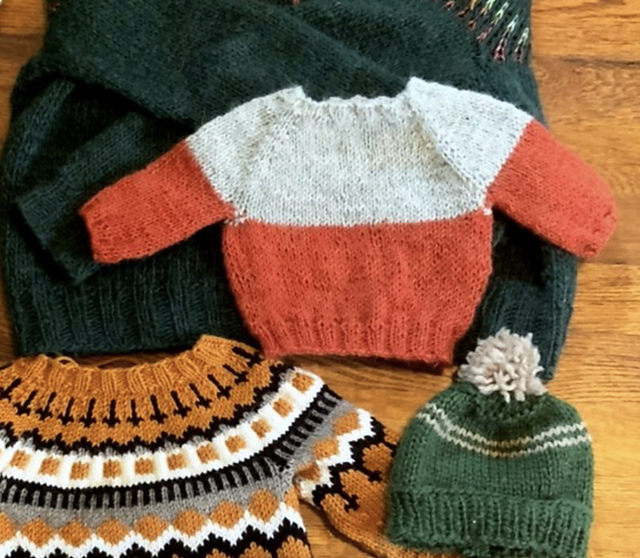
But over the years, my motivations have shifted. Now that I’ve proven to myself over and over that I can finish, I care more about other things: the quality of my work, the difficulty of my project. In my early knitting days, I’d choose projects based on the weight of the yarn (skinnier yarn = more knitting, whereas bulkier yarn = less knitting), and construction methods that sounded easy or I felt comfortable with.
I don’t know if I was actually aware of the fact that more complex techniques or projects that called for more knitting intimidated me, but they definitely did. I’d look longingly at the many beautiful fingering weight (the skinniest yarn that one would usually use) sweaters I saw online, but didn’t feel capable of actually knitting one. And creating one of the complex, Irish cable knit sweaters that I so admired felt completely out of reach–they were all knit back and forth, and then seamed. Just the word seamed was enough for me to keep on scrolling.
This shifted slowly: project by project.
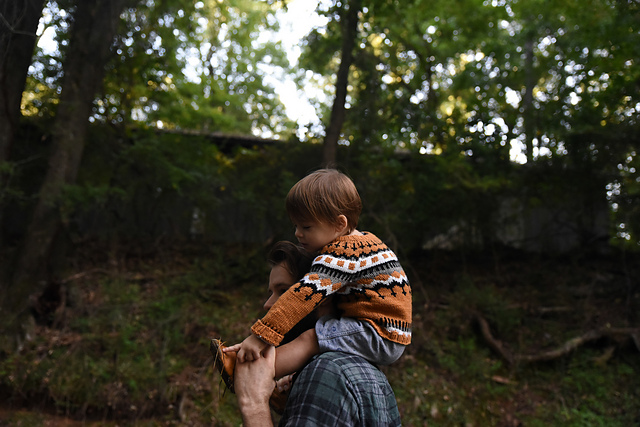
For a long time, I looked for only top down sweaters, which start at the collar and then are knit downwards, toward the hem. I liked them because you can try the sweater on as you go, ensuring that you have the length you want. They also felt easy–you start with relatively short rounds as you knit the neck, and then slowly increase as you create the fabric that drapes over your shoulders, chest, and back. I felt like they eased me into the project.
But then I found a sweater pattern for L that called for being knit bottom up, and I couldn’t resist giving it a go. It was also fingering weight–my first ever fingering weight sweater. But I was surprised to find that I really enjoyed both new elements of the project. I knit it in record time. Even though each stitch was so much smaller than I was used to, I found that I could knit much more quickly with the smaller yarn.

I also found that the new construction (starting at the seams, knitting the bottom half of the body, then casting on each sleeve and knitting until I reached the spot where the sleeves joined the body), broke the project up and made it feel like it was going more quickly than usual.
By the end of the project, I had a gorgeous sweater on my hands (that my son absolutely refused to wear, but that’s another story–good thing I had multiple kids, because the second kiddo was happy to inherit it), and I’d proven to myself that I both could try a new sweater construction, and that I could knit with fingering weight yarn in a larger project.
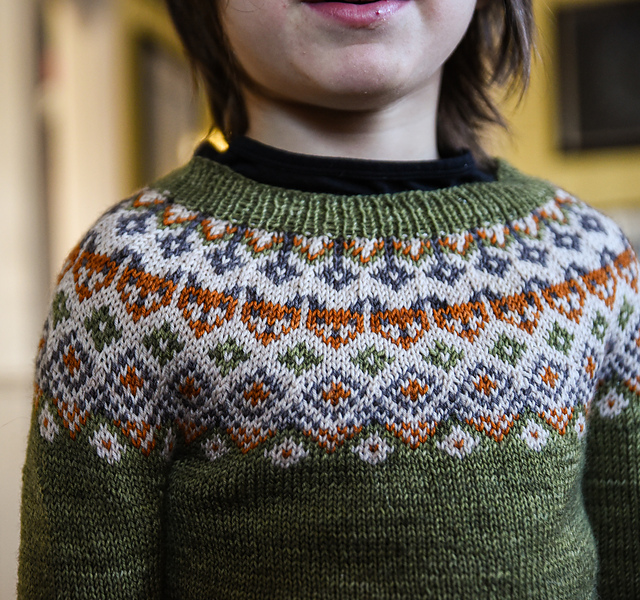
Even with my latest success under my belt, I still felt leery of projects that called for larger amounts of fabric, or complex techniques. I think that some part of me was worried I’d burn out, and not be able to finish, or that I just straight up wouldn’t be able to do it–even though at this point I’d been knitting for over 12 years and had mastered countless techniques.
Next on my list was the Miles Shirt Jacket. I’d fallen in love with its clean lines and cozy, over-sized fit, and I had visions of throwing it on for early morning, misty hikes (specifically, I was picturing the 2005 Pride and Prejudice meadow scene, where Mr. Darcy and Elizabeth converge in the mist and make out, except without Mr. Darcy present, or maybe subbing Jordan for him. I don’t know who would’ve been watching our kids in this scenario, but I do know that I was definitely wearing this sweater).
I was determined to make it, even though it required a completely new construction (I’d only knit one other cardigan, a small one for 2-year-old L), and was made with unspun wool, a type of wool that isn’t spun into a sturdy thread, but instead must be carefully pulled off of a plate.

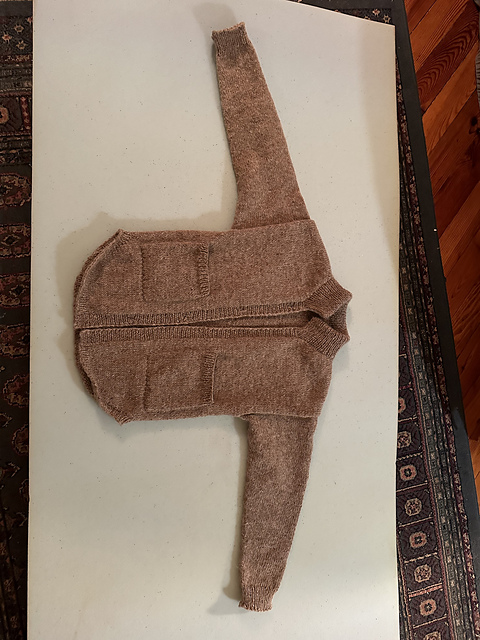
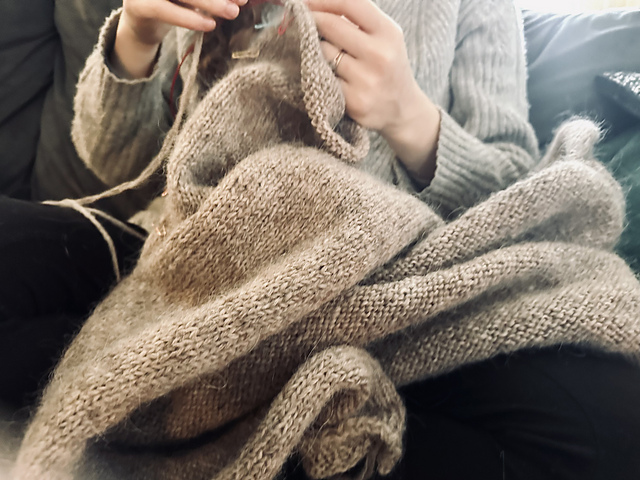
This one was less fun to make. The wool was extremely itchy, and whenever I worked on it, it scratched at the poor, over-stretched skin on my very pregnant belly (which was already itchy enough on its own). It also broke constantly, and I was repeatedly having to splice strands of yarn together again. Finally, I found the large amounts of stockinette (knitting lingo for just plain knitting) relentlessly boring.
The sweater actually reduced me to a sobbing wreck, when shortly after my mom died (and shortly before W was born), I tried to bind off the hem using the fancy hand-sewn tubular bind off that the pattern called for, and the yarn kept breaking. I finally had to rip back several rows, reknit them, and use a plain old bind off.
But even though the process had been painful, I’d proven to myself that I could do it–and I absolutely loved the finished result. I haven’t worn the sweater out tromping through dewy fields nearly as much as I’d perhaps imagined, but I do throw it on at every opportunity. And surprisingly, the itchy yarn that plagued me so much through the knitting process now doesn’t bother me at all. I once even tried to go to sleep in it (until Jordan begged me to take it off, because the itchiness was driving him crazy).
This project, with the expansive amount of fabric that I’d had to make and new construction, gave me the confidence to knit a project that had long been on my bucket list: the Awen sweater, a gorgeous cabled sweater that’s knit in pieces and then seamed. I’d knit several cabled things in the past, and every time I’d found myself dreading the cables, so I felt dubious of my ability to finish something so heavily cabled and on the scale of a sweater.
But at that point, I’d already had the yarn for it in my stash for a year, and I finally felt like I had the mental space to give it a shot. So this past fall, I cast on first my swatch, and then the first sleeve. The first sleeve was slow going–the main cabled motif was complex and difficult to memorize. But eventually, I did memorize it. By the time I got to the second sleeve, I raced through it–cabling no longer gave me pause, and I didn’t need to consult the pattern to make sure that I was on track. It was the same story for the two body pieces: I slowly knit the back, and then quickly knit the front.


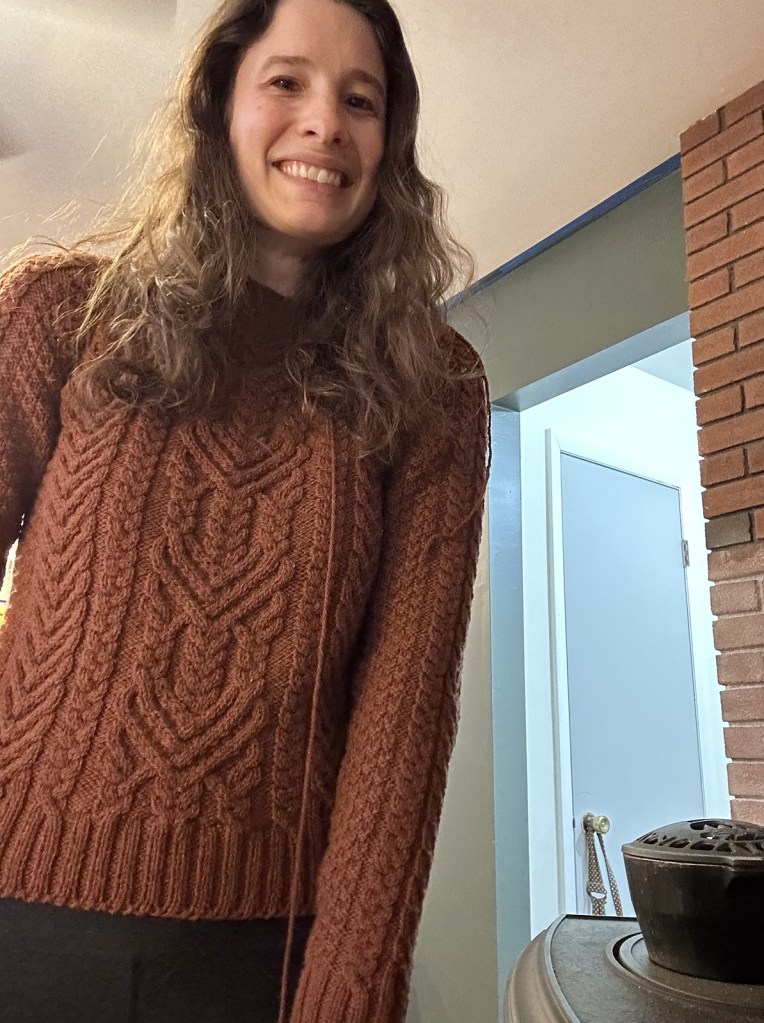

To my immense surprise, I LOVED working on it. Unlike the previous sweater, I never felt bored, never even felt the urge to speed up the process to get to the end. I loved how rhythmic the pattern was, how no row ever felt too long, because it was all knit in pieces. And I loved watching as the pattern slowly grew and unfolded from my needles.
My only real stressor was whether it’d fit (and next time I knit one of these sweaters, I do think I’ll go up a size for a more oversized fit). But in the end, it did fit, and it’s a gorgeous sweater that I can’t believe I created.
Two years ago, this kind of piece was purely aspirational for me–something that I might have dreamed about making, but that I never expected to have the skill or patience to finish. I can’t express how exciting it was to finally have not only knit a piece like this, but to also have enjoyed it.
It means that even though this sweater was imperfect–the fit not exactly to my liking–that I can do it again. And again. That I can continue to hone my craft, and perfect my skill.
At this point in my knitting journey, I’ve knit many different things of varying difficulty–a stuffed bear, bonnets and hats, many different sweaters, socks. You name it, I’ve probably at least thought about knitting it. But this sweater was a different level of skill and commitment for me.
Since I finished my Awen sweater, I’ve been working on a Book Club Cardigan alongside two of my knitting BFFs. It’s a cabled cardigan–with a construction that blends the Awen with the Miles Shirt Jacket sweater that I knit last winter.

In many senses it’s got a more complicated construction than the Awen pattern (even though the cabled pattern is much simpler, the pattern is poorly written, making it more of a challenge). But after having completed so many different types of sweaters that are constructed in different ways, I feel much more confident about my ability to complete this one.
In a marked change from knitting my last cardigan, I actually know what part of the sweater I’m knitting at all times–and instead of leaning on the pattern constantly to know what to do row by row, I feel much more confident having a rough idea of where it’s going and what I need to do (of course, this confidence comes with drawbacks, like the fact that I accidentally knit the body longer than I was supposed to, and so will have to seam the armholes to the proper size). But it’s really neat to knit a tricky pattern like this, and to feel fully literate in what’s happening and why.
There’s no real point to all this blathering on about knitting, other than to say: woah, it’s pretty cool to develop a skill over decades and watch it unfurl. How cool that each of those tiny stitches was a vote of confidence to myself–a tiny little “yeah, you can do this!” over and over again, that added up to entire beautiful sweaters and a hobby that I could happily devote hours to every day for the rest of my life.
I hope that you have something like that in your life.
 Feathery Thoughts