Two months ago, my Grandma Izzy died.
She was 97 years old, so it shouldn’t necessarily have come as a surprise to me. But it did. It swept me right off my feet.
We saw her the weekend prior, and she’d quizzed Jordan about all of the wild animals he’d gotten to see lately at his work and sat at the table with W on her lap, holding him in place with a loose arm looped around his legs as he wolfed down her sandwich. She was sharp and funny and as wonderful as ever.
“I don’t usually like to celebrate my birthday,” she told me as we sat next to each other on the couch after lunch. “But this year.” And she shrugged, in that characteristic Izzy way of hers.
She did get to celebrate her birthday. And she also got to eat the clam steamers that she’d requested for the celebration (I talked to her on the phone that day and she said, “They were mediocre,” and then, with that same shrug in her voice “Well.” As in, “What can you do? That’s life.“
And then the next day, she was gone.
I could write volumes about my grief, but that’s not why I’ve opened this tab and begun to type. Instead, I want to write about Izzy–who she was, why she mattered.
I was so incredibly lucky to be born into a lineage of the most incredible women. My grandma was a social work professor for Rutgers University and then, in her retirement, she advised PhD students at Yeshiva University into her 90s. Rutgers even published a piece about her passing.
Her accomplishment as a scholar is made especially incredible when put into historical context. She was born in 1928–and beginning her career during a time famous for the model of the “perfect American family” where women stayed home with the kids and the men went to work.
Not my grandma. She’d begun her education at Skidmore College and then went on to get her PhD at Rutgers. Along the way, her and my grandpa Mel had three kids–my two uncles and my mom. When I asked my grandma about those days, she talked about how hard she had to work to juggle it all, how she’d bring her papers home and work late into the night, and how her own mom, Sybil, often took the kids while she was working.
She rejected many of the stereotypes held at the time, and her and my Grandpa, Mel, worked in tandem to create a home filled with warmth and love. She spoke laughingly about how traditional her own mom was–insisting that the women wait on the men.
My grandparents’ sense of equality and deep adoration of each other was so palpable that it drew people to them. Their house was known for being the best hang out spot, with all of my mom’s friends flocking to lounge on their squashy couches and swim in their pool. They hosted an exchange student, Bergamo, when their kids were in high school, who became a dear family member. And they made many other lifelong friends around the world–in Scotland, Japan, New Zealand and England (and others too, I’m sure, these are just the people who stand out to me). Their doors were always open to graduate students who were feeling homesick or anyone in the community who needed them.
I suspect that the ample generosity that flowed through my grandparents came in part from their own parents. My grandma grew up in Brooklyn, with a best friend across the street, Minerva, who’d lost her mother at an early age. My grandma spoke fondly of how her own parents loved Minerva and her sisters, and how her mother became a surrogate mother to them.
Generosity was also a deep legacy on my grandpa’s side–in an old family history book, I found an anecdote that relayed that my grandpa’s father, who owned a shop in Baltimore, was known for how he’d help people in the community–and how he’d even apparently gifted a wedding dress to a community member who couldn’t afford one.
I was lucky enough to grow up in the warm beam of that generosity.
I was born in the Midwest, in the town where my parents had first met, but around the time I turned four, my mom and dad decided they didn’t want to live so far from my mom’s wonderful parents. I remember my mom saying, “I just can’t stand to think I’ll only see them twice a year for the rest of my life.”
My grandpa rolled out the red carpet for my parents, visiting houses for them, touring towns, and delivering intel about where the best place to raise a family might be. And so we up and moved across the country, settling in a town in Central NJ, only one hectic but manageable 40 minute drive away from their house.
As a result, my childhood is peppered with memories of swimming in their pool and then dashing inside to the hot tub and then back out to the pool again (my grandpa shouting from across the pool that we had to rinse our feet before we jumped into the hot tub). Of piles of cousins lounging on their (increasingly squashy) couches. Of lengthy hide-and-go-seek games throughout their house–which had the perfect number of nooks and crannies. Of languorous, post meal conversations with everyone gathered around. Of their house: the thickly padded rugs, the walls decorated with artifacts from all over the world. Of walking through the door to platters of still-warm portabella mushrooms sautéed in butter and garlic, and chips and dip, and fruit and melty cheese.
Even more importantly, it is saturated with memories of her.
Sitting at the linoleum table in my grandparents’ kitchen, gazing at the wall of black and white photos with my grandma and sipping “Sybil tea” — black tea with milk and sugar, named after my great grandmother, having Izzy point out each person in the photos and share her memories of them.
Sleepovers at their house, with their itchy woolen blankets and cloud-soft mattresses, and all the times when I couldn’t sleep and would wander into the living room to curl up next to my grandma on the couch. She never could sleep either, and we’d talk late into the night, until finally I drifted off.
The time my Grandma and I took the train into NYC, just the two of us. I can’t remember precisely what we did, aside from eating at a fancy Thai restaurant. On the way home, we talked about how neither of us ever fell asleep on trains or in cars–and then we both promptly fell sound asleep, her head rested on top of mine. We woke blearily to find that we’d gone two stops too far, and we had to get off and call my grandpa to come and rescue us. We laughed about that memory for years and years.
Going shopping at the mall with her, and her insisting on buying me whatever expensive thing I’d eyed but hadn’t dared mention actually wanting–followed by her treating me to sweet, frothy drinks at the mall coffee shop, which I’d drink too fast while she sipped her own. I still remember the guilty, lucky feeling I always had and how it burned my cheeks every time we checked out.
All the many times that I played Scrabble or Words With Friends with her and she whooped my butt. And the many other times that I’d gaze wonderingly at her New York Times crossword puzzle and try to think up the answers so that I could scratch them in before her (I never could). That crossword puzzle was a staple on their coffee table–she even had special erasable pens for it.
The time my mom called me after my grandparents had met Jordan for the first time and said that they’d loved him so much that they’d raved about him, and that they hardly ever raved–and I knew that he’d gotten the full stamp of approval from my family.
The time when Jordan and I stayed for a sleepover at their house shortly after we got married. My grandpa was still alive then, and they treated us to dinner and then we all hung out and talked. I remember it feeling like a refuge from the realities of life as young adults.
Later memories, of her meeting our babies for the first time, and the deep joy and contentment radiating from her as she cradled each of them. Of the evening when Jordan and I brought an entire meal’s worth of groceries to her house and made her a lavish dinner that she raved about to all our relations (deeply embarrassing Jordan). Of the time we stayed there for a week to escape from an environmental hazard at our house, and she delighted in watching Bluey with the kids and celebrating L’s birthday with him.
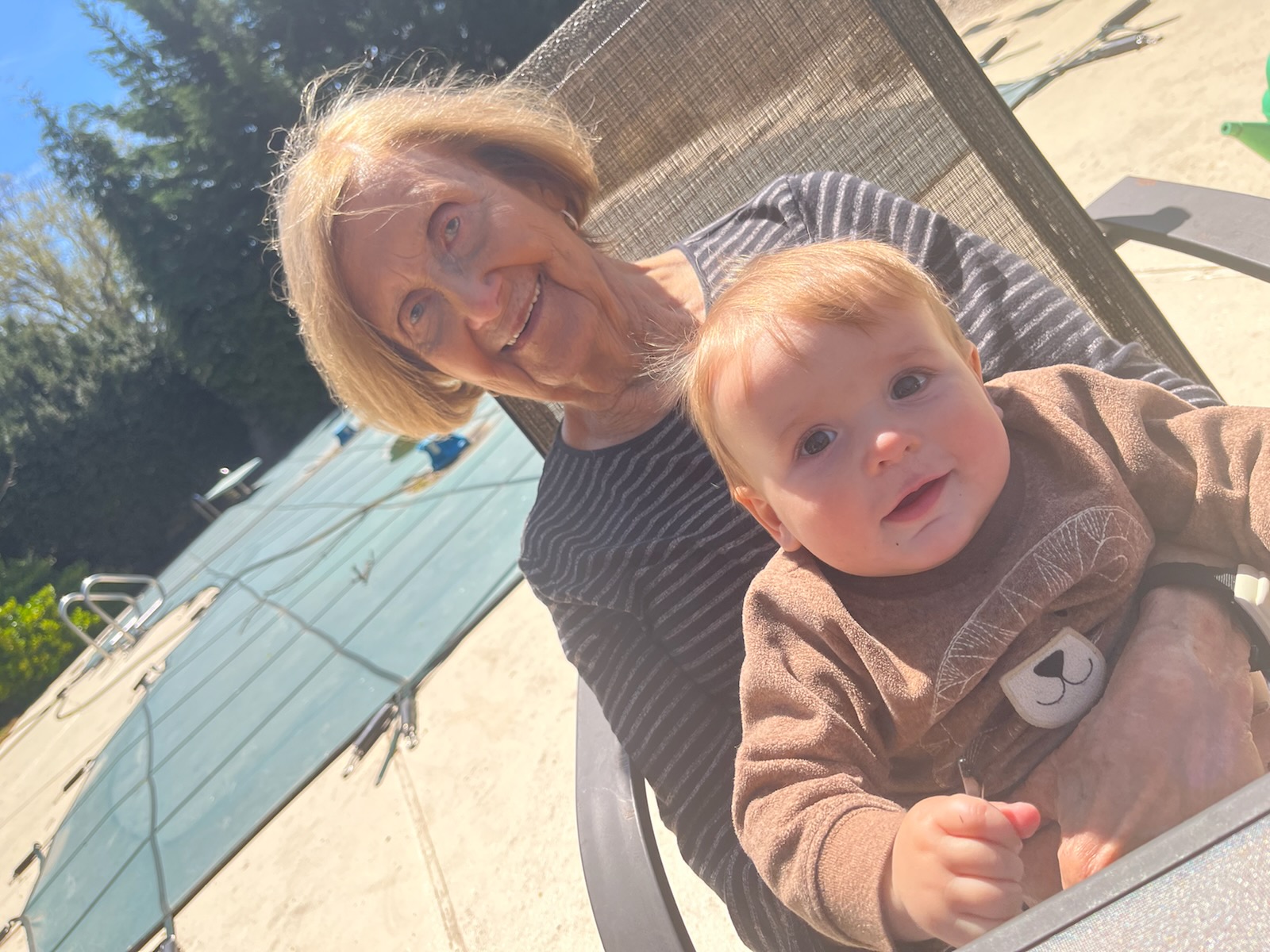
I wish I had more memories. I wish I could remember every single moment I ever had with her. But even without them, she exists in me in so many ways that it’s hard to count it all up:
I inherited her tendency to sit on her feet, even in restaurants. She recently told me that her father-in-law had always been shocked by her foot-sitting tendencies–which I hadn’t known, even though we’ve shared the trait since I was a child.
Speaking of feet, I inherited those too, with their long toes that are prone to bunions (I already have one forming, despite my commitment to foot-friendly shoes).
I inherited her inability to walk in a straight line (whenever we walked together, we’d gently bump hips every couple of steps).
Her laser focus on whatever she happened to be thinking about (which often resulted in what my mom called a “spacy professor” persona in her).
Her anxiety (which she passed on to my mom, who passed it on to me).
Her deep love for Indian and Thai food.
There are also the things that I’ve taken purposefully: a commitment to constantly learning, to being open to new thinking and ideas, to improving my mind through meditation and therapy. She was always trying something new: reading new books, trying new forms of meditation, attending new classes, meeting with a new therapist.
She was also always exercising. I remember trying to keep up with her on bike rides as a teenager, pedaling furiously up hills as she soared easily up ahead of me. Then there were other phases where she got into pilates, or lifting, and my grandparents got a whole new set up in their basement to reflect her interest. In her mid-nineties, she recruited a physical trainer at the YMCA to help her maintain her physical health, and did sessions with him on a weekly basis, throwing weighted balls and doing other exercises to keep herself fit.
While each of these efforts may not have lasted forever, they did last for years at a time–and she was consistent enough about them that she reaped the benefits, remaining physically and mentally healthy until her dying day. It was incredibly inspiring to watch up close, and is an ethic that I’ve tried to hug close to me–to not be afraid to push the mental and physical boundaries that I’ve set for myself.
It’s still hard for me to believe that she’s gone. She was such a pillar in my life–such an immense source of stability and safety, the last link to my family’s heritage, grandmother to my own children–that it is hard to wrap my brain around.
But then I sit on my feet.
But then my middle son says, “Well,” with a shrug, in exactly the same tone that she always used.
But then I pour myself a cup of Sybil tea.
And I know that she’s not gone. That her and my mom and all the generations of wonderful women before them still live on in us.
 Feathery Thoughts
what a wonderful tribute to Izzy. I remember her shrug and smile.